
Here is a list of the books that I have authored and co-authored. All of these books are available in print, ebook (Kindle) and audio formats. Click on each image to view more details about each book on Amazon.com. Some of these books have multiple language translations

|
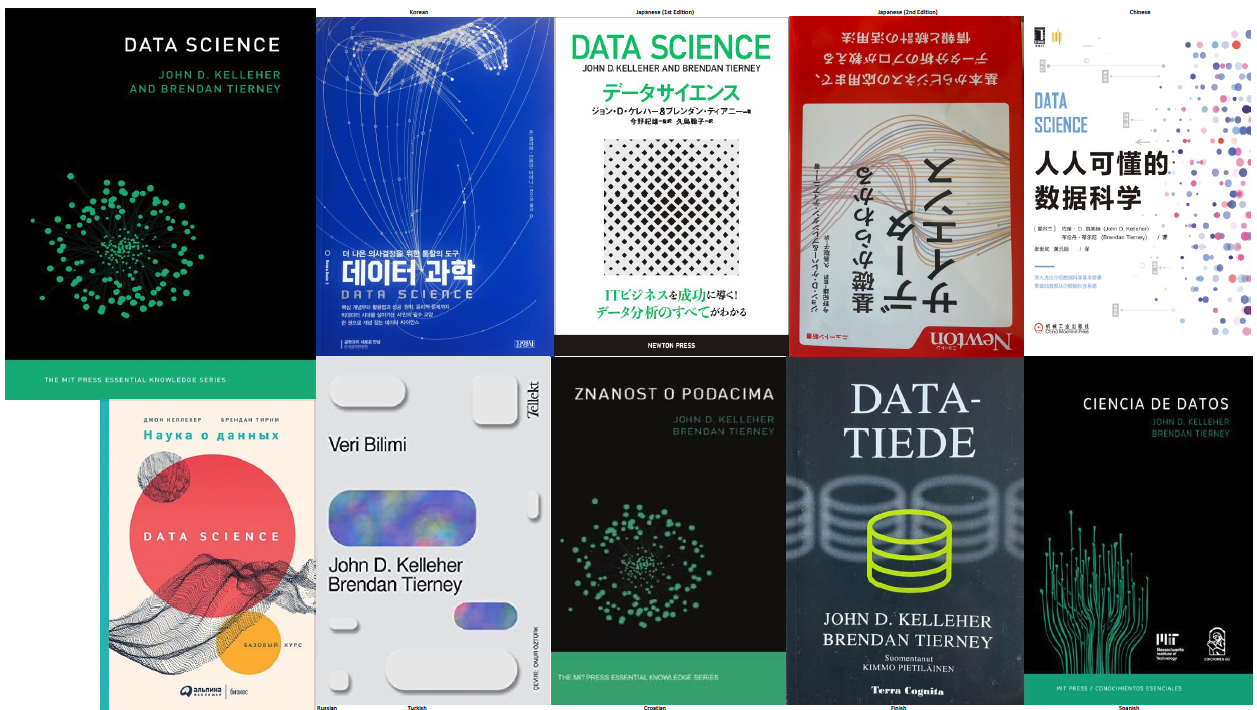
Co-written with John Kelleher, this book gives a concise introduction to the emerging field of data science, explaining its evolution, relation to machine learning, current uses, data infrastructure issues and ethical challenges the goal of data science is to improve decision-making through the analysis of data. Today data science determines the ads we see online, the books and movies recommended to us online, which emails are filtered into our spam folders, and even how much we pay for health insurance.This book is available in 9 languages including Spanish, Chinese, Japanese, Korean, Turkish, Croatian, Finnish and Russian.
The book was an Amazon bestseller and an international bestseller across many countries in 2018, 2019, 2020, 2021, 2022 and 2023. It is also one of the most cited texts in Data Science research.
|
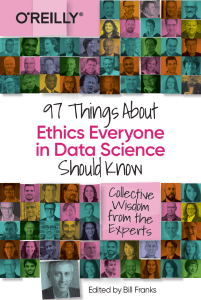 |
97 Thins About Ethics Everyone in Data Science Should Know.With this in-depth book, data professionals, managers, and tech leaders will learn powerful, real-world best practices and get a better understanding for data ethics. Contributors from top companies in technology, finance, and other industries share their experiences and lessons learned on bias, privacy, security, and data governance—the things you need to know for ethically collecting, managing, and using data.
I wrote some chapters for this book. |
 |
I wrote some chapters in this book along with the Introduction section. This book is co-authored by 5 Oracle ACE Directors, the technical editor was an Oracle ACE Director and the Foreword was written by an Oracle ACE Director. Yes that was 7 Oracle ACE Directors involved in this book. |

The Oracle Advanced Analytics Option consists of two components. I’ve written the two books that cover these components.
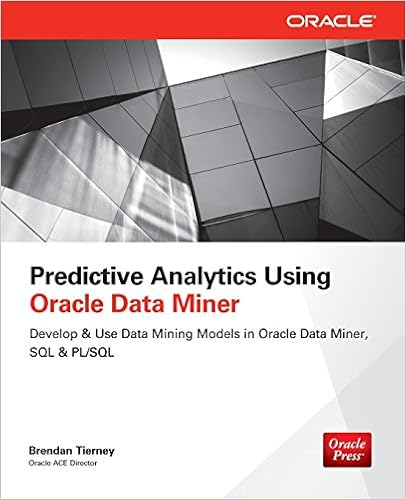 |
This book is really divided into 2 parts. The first part looks at how you can use the Oracle Data Miner tool to build workflows using the most commonly used data mining algorithms. The second part brings you through the same process using SQL and PL/SQL.You can look at this book as a step-by-step series of tutorials on how to use the in-database data mining algorithms that come with Oracle Advanced Analytics option.This book will not teach you about predictive analytics or data mining algorithms. It is assumed you have some prior knowledge of these algorithms and when and how to use them. |
 |
This book will take you through the main features of Oracle R Enterprise. The book assumes some prior knowledge of the R language and some of the various statistical and machine-learning features of the R language. As you work through each of the chapters you will learn how Oracle R Enterprise combines the power of the R language with that of the Oracle Database. In addition to covering the transparency layer, you will learn how to work with storing R scripts in the database. This allows you to use the power and scalability features of the Oracle Database to work with larger volumes of data than usual. You will also learn how to expose your R scripts using SQL. This particular feature allows you to include the advanced analytics and machine learning techniques of the R language in all your applications, using SQL. |
 |
Co-wrote a chapter in this book with Bruno Ohana titled, Opinion Mining with SentiWordNet. This chapter focuses on the area of opinion mining and discusses the SentiWordNet lexicon of sentiment information for terms derived from WordNet. The results of the research in applying this lexicon to sentiment classification of film reviews along with a novel approach that leverages opinion lexicons to build a data set of features used as input to a supervised learning classifier are also presented. Furthermore, the results obtained through the research are in line with other experiments based on manually built opinion lexicons with further improvements obtained by using the novel approach, and are indicative that lexicons built using semi-supervised methods such as SentiWordNet can be an important resource in sentiment classification tasks. |
 Ora-lytics
You must be logged in to post a comment.