
OTN
VM for Oracle Data Miner
Recently the OTN team have updated the ‘Database App Development’ Developer Day virtual machine to include Oracle 11.2.0.2 DB and SQL Developer 3.1. This is all you need to try out Oracle Data Miner.
So how do you get started with using Oracle Data Miner on your PC. The first step is to download and install the latest version of Oracle VirtualBox.

The next step is to download and install the OTN Developer Day appliance. Click on the above link to go to the webpage and follow the instructions to download and install the appliance. Download the first appliance on this page ‘Database App Development’ VM. This is a large download and depending on your internet connection it can take anything from 30 minutes to hours. So I wouldn’t recommend doing this over a wifi.
When you start up the VM your OS username and password is oracle. Yes it is case sensitive.
When the get logged into the VM you can close or minimise the host window

There are two important icons, the SQL Developer and the ODDHandsOnLab.html icons.
The ODDHandsOnLab.html icon loads a webpage what contains a number of tutorials for you to follow.

The tutorial we are interest in is the Oracle Data Miner Tutorial. There are 4 tutorials given for ODM. The first two tutorials need to be followed in the order that they are given. The second two tutorials can be done in any order.
If you have not used SQL Developer before then you should work through this tutorial before starting the Oracle Data Miner tutorials.
The first tutorial takes you through the steps needed to create your ODM schema and to create the ODM repository within the database. This tutorial will only take you 10 to 15 minutes to complete.
In the second tutorial you get to use the ODM to build your first ODM model. This tutorial steps your through how to get started with an ODM project, workflow, the different ODM features, how to explore the data, how to create classification models, how to explore the model and then how to apply one of these models to new data. This second tutorial will take approx. 30 to 40 minutes to complete.
It is all very simple and easy to use.
The First Oracle Magazine–Volume1 Issue 1
In my last blog post I reviewed the contents of the March/April 1996 edition of Oracle Magazine. While doing this I noticed on the Editors Pages, Julie Gibbs gave a review of the very first Oracle Magazine from 1987.
Here is the front cover of the first Oracle Magazine. I’ve scanned the editors page, containing the review. Just click on the image below.
![527610_463186290364358_114144098601914_2017027_29908051_n[2]](https://i0.wp.com/lh3.ggpht.com/-U9REspyqmrY/T7yqiCH6KNI/AAAAAAAAGWM/R1pwCmFj7xA/527610_463186290364358_114144098601914_2017027_29908051_n%25255B2%25255D%25255B6%25255D.jpg "527610_463186290364358_114144098601914_2017027_29908051_n[2]")
The first edition had just 12 pages of content.
Here is the extract from the editors page March/April 1996:
“The picture you see on this page is of the first cover of Oracle Magazine-Yolume I, Number I, June 7987. Yes, we are celebrating our tenth anniversary this year. Ten years may not seem like much in other industries, but in high tech, it’s a veritable lifetime. Companies and products have come and gone-where ate you now, VisiCalc? How about the PC jr? And who knew in 1987 that the Internet would be the dominant topic of the high-tech press in 1996?
What was in the first issue of Oracle Magazine? Here’s a sampling of articles in that 12-page fledgling publication: New Network Expands Customer Support (24-hour online support was introduced June I, 1987);
Oracle Version 5 .1 Released; Oracle RDBMS Now Available on Wang VS; Oracle Exceeds First HaIf Forecast (revenues for the first half totalled almost $46million); UniForum: Site of Oracle UNIX Announcements (at the time, Oracle ran on more than 20 platforms, including new
UNIX ports to NCR, Sun, DEC Ultrix,Sequent, Altos, and Plexus); SQL Declared Standard Language by ANSI; Double DEC Awards for Oracle (Digital Review’s Target Awards gave Oracle first place for “Best Database Management Product” and the No. I rating in the “Digital News 50”).”
Some people say that Oracle Magazine existed before 1987. Oracle did have a newsletter type publication.
To view the cover page and the table of contents click on the image at the top of this post or click here.
My Oracle Magazine Collection can be found here. You will find links to my blog posts on previous editions.
Review of Oracle Magazine–March/April 1996
The headline articles for the March/April 1996 edition of Oracle Magazine was Oracle’s first or early articles on Data Warhousing, including DW Architectures, what Oracle tools you can use, multi-dimensional analysis, Oracle Express and future directions of data warehouses.
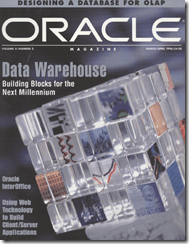
Julie Gibbs, the editor of Oracle Magazine, wondered ‘What will be hot in 2005?’. Some of her predictions/suggestions were:
- Will Larry Ellison’s NC provide every home with a $500 internet box
- What will be the 3 biggest software companies and were any of them around in 1995
- How many people will use the internet everyday
- Will the internet be censored ? How and by whom ?
- Or will the internet be passe and will virtual reality be a reality
- What will be the size of the largest data warehouse
- Will Apple still exist
- Will you be reading your magazines in print or online
- Will your company have a woman CEO
- How many people will be telecommuting
- Will every desktop have built in video conferencing so that you can talk to your coworkers
Other articles included:
- Oracle Interoffice Suite was released and comprised Messaging, Document and Workflow servers based on Oracle 7.3. The product provided groupware functions, such as electronic mail, messaging, scheduling, directory services, document management, workflow and conferencing.
- Oracle 7.3 new features included Oracle Enterprise Manager, Oracle Software Manager, SQL*Net 2.3, advanced replication and Oracle ConText.
- How to rename your database. It is not always optimal for a database to keep the name it was born with. A step by step guide is given on how to do this without loosing any data!
- A case study is presented from NeXT Computer on how to audit and clean up your Oracle Applications data as you prepare to upgrade to Release 10. These included:
- Review Usernames and unused responsibilities
- Unused menus and menu options
- Are outdate concurrent requests being purged
- Unused printers
- Identify cluttered production libraries
- Unused custom concurrent processes
- Unused database objects
- Inactive vendors and invalid distribution sets
- Unused payment terms
- Closed bank accounts
- Protecting your budgets
- Obsolete journal sources
- Invalid price lists
- Unbooked orders and unclosed orders
- Unused payment terms, transaction types, units of measure and inactive sales people
- How to design a database for OLAP. Most of the following steps still stand today for designing your star-schemas
- Define the question (business function/area)
- Use Normalized logic
- Identify Dimensions
- Create Hierarchies
- Identify Attributes
- Identify Measures
- Add Calculations
- There was a review of the very first Oracle Magazine that was published in June 1987. Watch this space, as I will be posting the details soon.
To view the cover page and the table of contents click on the image at the top of this post or click here.
My Oracle Magazine Collection can be found here. You will find links to my blog posts on previous editions.
Oracle Magazine-May/June 1995
The headline articles for the May/June edition of Oracle Magazine included one of the first articles on Data Centers,using the prebuilt packages in PL/SQL and how to use object-oriented programming techniques in Oracle Forms 4.5

Other articles included:
Oracle 7 Internet Access Kit also called the Oracle World Wide Web Interface Kit. Developers could use this kit developers can create links between web servers and Oracle 7 databases. The Oracle WWW Interface Kit included:
- Oracle’s Web-Oracle-Web (WOW) PL/SQL gateway to web servers
- Oracle’s PL/SQL editor and development tool for creating dynamic PL/SQL
- PERL, a freeware interpreting programming language
- ORAPERL, an extension to PERL for use with Oracle 7 databases
- ORAYWWW, a PERL gateway
- WORA, a user-friendly database browser written in Pro*C
- DECOUX, a post-processing gateway that inserts query results from a Oracle 7 database into HyperText Markup Language (HTML) documents
- Navigator, a collection of PERL scripts and one Pro*C module that enables administrators to quickly configure HTML forms for end user queries
- Text Search System (TSS), an indexing and free text search system
- MORE, a collection of Pro*C gateways for maintaining an information repository
- HotMetal, a HTML editor
Fee access to Oracle ConText. Oracle customers were offered an opportunity to try ConText before you buy. According the the article Oracle ConText is a revolutionary linguistic analysis program that automatically generates back-of-book indexes and reduces the volume of text to a summary.
Ken Jacobs gives the second part of his in-depth article on the latest release of Oracle 7.1 and Oracle 7.2 databases. Ken was vice president of Product Planning and has been working with Oracle since version 2 of the database.
Mike Ault has an article on using DBMS_PIPES PL/SQL package, how to access the shared pool using the DBMS_SHARED_POOL PL/SQL package and how to use the DBMS_OUTPUT procedure.
How big is your database ? Oracle conducted a survey of all its customers to see what was the typical size of their databases and how many users each database would have. The following diagrams gives the results of this survey and compares the 1994 results with the results from 1993. We can see that there was a bit of a jump on the size of the databases but the number of users increased significantly


So must customers had databases in the 2GB to 10GB. How things have changed. If the survey was conduced for 2012 what results would be get ?
In 1995, Oracle Open World took place in Yokohama, Japan between 18th and 19th January. It had 130 seminars and sessions. In 2012 OOW will have over 500 sessions and will run over 5 days!
To view the cover page and the table of contents click on the image at the top of this post or click here.
My Oracle Magazine Collection can be found here. You will find links to my blog posts on previous editions.
How big was your Oracle Database in 1993 & 1994
I’m in the middle of writing my summary of the May/June 1995 edition of Oracle Magazine (that blog post is coming soon). There was a one article about a survey that Oracle conducted of its customer on how big their databases were and the number of users for their databases.
The follow diagrams gives the summary results of these surveys.
We can see that there was a bit of a jump on the size of the databases but the number of users increased significantly
![image_thumb[2]](http://lh5.ggpht.com/-ufVBszAKxsQ/T5e7sqdzCRI/AAAAAAAAATo/AMvbBrZp-pk/s1600-h/image_thumb%25255B2%25255D%25255B3%25255D.png "image_thumb[2]")
![image_thumb[4]](http://lh6.ggpht.com/-rhi7Y-yWwzk/T5e7utywrHI/AAAAAAAAAT0/rNMFJuNFTss/s1600-h/image_thumb%25255B4%25255D%25255B3%25255D.png "image_thumb[4]")
So must customers had databases in the 2GB to 10GB. How things have changed. If the survey was conduced for 2012 what results would be get ?
Does anyone know if Oracle has published similar survey results in the last few years ?
Oracle Magazine–March 1995
In 1995 we have a change to the frequency of publication of Oracle Magazine. It is not published every 2 two months with 6 editions each year, as it is still the case.
The headline articles in the March/April 1994 edition of Oracle Magazine included Integrating Unstructured Information, Minimizing Client/Server Network Traffic with Oracle Forms 4.0, Relational Objects and how the Canadian Postal Service was using Oracle Technology to deliver mail on time.

Other articles include:
Dynamic SQL Comes to PL/SQL: Introduces us to the DBMS_SQL package. A useful quick reference one pager is given giving the details of each of the 15 procedures and functions, including, BIND_VARIABLE, CLOSE_CURSOR, COLUMN_VALUE, DEFINE_COLUMN, EXECUTE, EXECUTE_AND_FETCH, FETCH_ROWS, IS_OPEN, LAST_ERROR_POSITION, LAST_ROW_COUNT, LAST_ROW_ID, LAST_SQL_FUNCTION_CODE, OPEN_CURSOR, PARSE, VARIABLE_VALUE.
Personal Oracle 7 for Windows gets released and it now has a graphical administration tool to allow us to manage the database, including users, backup and recovery managers along with export/import and SQL*Loader and Oracle Objects for OLE. The hardware requirements included 8Mb of RAM and less than 30Mb of hard-disk space. How things have changed!!!. It was capable of running on Window 3.1 and was Windows 95 ready.
Rollback segments in in Oracle 7 allows use to now effectively manage our transactions. It gave the following recommendations:
- Create a separate tablespace for rollback segments for administrative and monitoring purposes
- Se the size of the tablespace according to the number and storage parameters of the rollback segments
- Place your rollback segment tablespace on a separate disk device, if possible. Consider total I/O activities and spread I/O over available disk devices
- Create one rollback segment for every four concurrent transactions
- Don’t create more than 50 rollback segments
- Create smaller rollback segments for OLTP applications. This increases the likelihood that rollback segments will be cached in SGA according to the least recently used algorithm, resulting in performance gain
- Create larger rollback segments for decision support or back processing applications
- Set initial to you average transaction size, set OPTIMAL to four to eight times larger than INITIAL
Oracle Magazine goes digital and interactive with a CD-ROM containing every issue of published in the previous two years and also contained a map of Oracle offices worldwide.
To view the cover page and the table of contents click on the above image or click here.
My Oracle Magazine Collection can be found here. You will find links to my blog posts on previous editions.
OTN Workshop Days in Dublin 17-
Oracle in Ireland have arranged a number of FREE Oracle Technology Network Hands on Workshops.
17th April : Database Firewall
18th April : Oracle Real Application Testing
19th April : Database 11g R2 New Features
20th April : Business Integration using Oracle SOA Suite 11g
All the workshops are in the Oracle offices in East Point, in Dublin.
To register for these events
Oracle Magazine–Winter 1994
The headline articles of the Winter 1994 edition of Oracle Magazine included topics on how an energy company migrated to client/server, towards the paperless office (it never really happened!!), Business Processing Reengineering and document management.

There was a noticeable number of articles and advertisements on reporting tools. The tools mentioned included Oracle Browser version 2.0, Oracle Data Query, Impromptu, Intelligent Query (IQ), Visual CyberQuery, R&R Report Writer, ReportSmith and SQL Assist
There was also an article called ‘An Elegant Approach to Report Generation’ and looked at how you could take the ASCII file produced by a SQL report and load it into a WordPerfect template.
We have the first mention of on Oracle Certification. ‘Database administrators and application developers can now become Oracle Certified to demonstrate their skill and competence in using Oracle systems. ……. Upon successfully completing the exam – which covers such areas as using SQL and Oracle Forms, tuning applications, and administrating and Oracle database – students will be awarded with the title of Oracle Certified Administrator and/or Oracle Certified Application Developer’.
Oracle announces the launch of their Real-Time Support System. Unlike My Oracle Support we have today, back in 1994 you needed a modem and remote communications package that could emulate a SQL*Forms support terminal type.
There was an article, by Kevin Loney, on how you could add Help documentation to your Oracle Forms applications using Oracle*Text Retrieval 2.0.
Finally there was an article by the IOUG about their International Oracle User Week in 1993. This event was held in the Orange County Convention Center in Orlando FL, where there was an attendance of 3,300 participants. This conference has since been expanded and is now call COLLABORATE and will be in Las Vegas in 2012 on 22-26 April (I wish I could be there).
To view the cover page and the table of contents click on the above image or click here.
My Oracle Magazine Collection can be found here. You will find links to my blog posts on previous editions.
Oracle Magazine–Fall 1993
The headline articles of the Fall 1993 edition of Oracle Magazine included topics on Multimedia Servers, Free Space Defragmentation and Geographic Information Systems.

Apart from the head line articles most of the other articles were about product announcements/updates and about how certain types of companies were using IT.
The main technical article was by Kevin Loney on freeing up free space in an Oracle 6 database using defragmentation. This was a popular topic for Oracle version 6 and 7, when disk space was expensive. It is less of an issue today.
There was an article on the Digital Highway and in Multimedia Servers. These were early indicators of Larry’s investing in the Video On-Demand servers.
The first maintenance release of Oracle 7 database was announced (Oracle 7.1), with enhancements centred around:
- Parallel Operations : performance increases, splitting of query execution, data loading and index creation tasks and execute them concurrently on multiple CPS. Permits multiple sessions running SQL*Loader using the fast bulk load i.e.direct path
- Application Development : Users can now embed PL/SQL functions in SQL statements and reference those functions in SQL expressions as if they are build-in.
- Administration : Tablespaces can be placed in read-only mode. Provides a parallel recovery mechanism.
- Standards Compliance : Oracle 7.1 is compliance with the SQL92 Entry Level standard. The ORDER BY clause can not reference SELECT list items names with a column alias.
Some of the products discussed in articles included Pro*C version 2.0, SQL*Module version 1.0, OracleWare, Oracle Graphics version 2.0, SQL*Net version 2 on MVS, SQL*Connect to SQL/400 and Oracle Card 2.0.
Apart from these product related articles, some others of interest included an advertisement for ERwin which was a product owned at that time by Logic Works.
There was a short article on the IOUG 12th Annual User Group Conference in September.
To view the cover page and the table of contents click on the above image or click here.
My Oracle Magazine Collection can be found here.
My previous posts on Oracle Magazine
– Winter 1993
– Fall 1992
Rewards received in the Post today
Today I arrived home from work to find that I had received 2 parcels.
In the first parcel was

Thank you Oracle ACE Programme and OTN.
In the second parcel was an IOUG Select Contributors T-shirt. I received this because I had an article in the Q1 2012 edition of IOUG Select, on Oracle Data Miner. Thank you IOUG.
Oracle Magazine–Winter 1993
The lead articles in the first Oracle Magazine of 1993 (winter) were about how the Oracle database was being used in the Toronto Stock Exchange and in the Municipio de Panama of Panama City.

Other articles of interest included
- Cary Millsap on the Optimal Flexible Architecture. Was this Cary’s first article in Oracle Magazine ? OFA provided a set of guidelines on how to install Oracle so that performance is not affected as your database environment grows. Cary gives 3 basic rules for creating and ODA compliant Oracle database (the full set is in the article).
- Establish and orderly operating system directory structure in which any database file can be stored on any disk resources (applicable to operating systems with hierarchical directory structures only).
- Separate groups of segments with different behavior into different tablespaces.
- Maximize database reliability and performance by separating database components across disk resources
- There was 2 articles that looked at OODBMS. Oracle made their first purchase of an OODBMS company in 1994 and were trying to release their first OODBMS product in 1995. This never happened and their reverted to integrating some OODBMS features into the database instead.
- Oracle Glue is released. This product has gone through a number of name changes since. What is it called now ?
- There was a couple of articles discussing using UNIX or ALPHA server machines, when VLDBs were considered extremely large at 32GB. I remember there was one Bank who had the largest database in Ireland in 1993 and it was 4GB. I wonder what it is now.
- Business Object announces the release of their DOS and Windows end user data access tool for relational database tool.
- There was a number of adverts from companies providing tools and support for converting your Oracle Forms Version 2 to Forms 3
Click on the image above to view the PDF of the table of contents page.
New additions to my Oracle Magazine Collection
I put out a call a few months ago looking for help in completing my Oracle Magazine collection. I also had a letter in the Nov/Dec 2011 edition of Oracle Magazine looking for help.
The following people contacted me in December offering to send me some of my missing editions.
Lisa Dobson – Oracle DBA at Durham University and Vice President of UKOUG
Debra Lilley – President of UKOUG
Christian Antognini – Trivadis AG, Switzerland
Dan Vlamis – Vlamis Software Solutions, MO, USA
Many thanks for your donations.
It seems that people don’t keep their Oracle Magazines!
I’m now just missing a very small number of editions since 1992. Can anyone else help ?
Does anyone have any Oracle Magazines from before 1992 ?
The following table gives the current collection (printed editions). The grey boxes are the editions that I’m still missing, and keep an eye on my Oracle Magazine page for updates.

 Ora-lytics
You must be logged in to post a comment.