
Oracle
The First Oracle Magazine–Volume1 Issue 1
In my last blog post I reviewed the contents of the March/April 1996 edition of Oracle Magazine. While doing this I noticed on the Editors Pages, Julie Gibbs gave a review of the very first Oracle Magazine from 1987.
Here is the front cover of the first Oracle Magazine. I’ve scanned the editors page, containing the review. Just click on the image below.
![527610_463186290364358_114144098601914_2017027_29908051_n[2]](https://i0.wp.com/lh3.ggpht.com/-U9REspyqmrY/T7yqiCH6KNI/AAAAAAAAGWM/R1pwCmFj7xA/527610_463186290364358_114144098601914_2017027_29908051_n%25255B2%25255D%25255B6%25255D.jpg "527610_463186290364358_114144098601914_2017027_29908051_n[2]")
The first edition had just 12 pages of content.
Here is the extract from the editors page March/April 1996:
“The picture you see on this page is of the first cover of Oracle Magazine-Yolume I, Number I, June 7987. Yes, we are celebrating our tenth anniversary this year. Ten years may not seem like much in other industries, but in high tech, it’s a veritable lifetime. Companies and products have come and gone-where ate you now, VisiCalc? How about the PC jr? And who knew in 1987 that the Internet would be the dominant topic of the high-tech press in 1996?
What was in the first issue of Oracle Magazine? Here’s a sampling of articles in that 12-page fledgling publication: New Network Expands Customer Support (24-hour online support was introduced June I, 1987);
Oracle Version 5 .1 Released; Oracle RDBMS Now Available on Wang VS; Oracle Exceeds First HaIf Forecast (revenues for the first half totalled almost $46million); UniForum: Site of Oracle UNIX Announcements (at the time, Oracle ran on more than 20 platforms, including new
UNIX ports to NCR, Sun, DEC Ultrix,Sequent, Altos, and Plexus); SQL Declared Standard Language by ANSI; Double DEC Awards for Oracle (Digital Review’s Target Awards gave Oracle first place for “Best Database Management Product” and the No. I rating in the “Digital News 50”).”
Some people say that Oracle Magazine existed before 1987. Oracle did have a newsletter type publication.
To view the cover page and the table of contents click on the image at the top of this post or click here.
My Oracle Magazine Collection can be found here. You will find links to my blog posts on previous editions.
Review of Oracle Magazine–March/April 1996
The headline articles for the March/April 1996 edition of Oracle Magazine was Oracle’s first or early articles on Data Warhousing, including DW Architectures, what Oracle tools you can use, multi-dimensional analysis, Oracle Express and future directions of data warehouses.
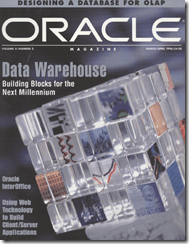
Julie Gibbs, the editor of Oracle Magazine, wondered ‘What will be hot in 2005?’. Some of her predictions/suggestions were:
- Will Larry Ellison’s NC provide every home with a $500 internet box
- What will be the 3 biggest software companies and were any of them around in 1995
- How many people will use the internet everyday
- Will the internet be censored ? How and by whom ?
- Or will the internet be passe and will virtual reality be a reality
- What will be the size of the largest data warehouse
- Will Apple still exist
- Will you be reading your magazines in print or online
- Will your company have a woman CEO
- How many people will be telecommuting
- Will every desktop have built in video conferencing so that you can talk to your coworkers
Other articles included:
- Oracle Interoffice Suite was released and comprised Messaging, Document and Workflow servers based on Oracle 7.3. The product provided groupware functions, such as electronic mail, messaging, scheduling, directory services, document management, workflow and conferencing.
- Oracle 7.3 new features included Oracle Enterprise Manager, Oracle Software Manager, SQL*Net 2.3, advanced replication and Oracle ConText.
- How to rename your database. It is not always optimal for a database to keep the name it was born with. A step by step guide is given on how to do this without loosing any data!
- A case study is presented from NeXT Computer on how to audit and clean up your Oracle Applications data as you prepare to upgrade to Release 10. These included:
- Review Usernames and unused responsibilities
- Unused menus and menu options
- Are outdate concurrent requests being purged
- Unused printers
- Identify cluttered production libraries
- Unused custom concurrent processes
- Unused database objects
- Inactive vendors and invalid distribution sets
- Unused payment terms
- Closed bank accounts
- Protecting your budgets
- Obsolete journal sources
- Invalid price lists
- Unbooked orders and unclosed orders
- Unused payment terms, transaction types, units of measure and inactive sales people
- How to design a database for OLAP. Most of the following steps still stand today for designing your star-schemas
- Define the question (business function/area)
- Use Normalized logic
- Identify Dimensions
- Create Hierarchies
- Identify Attributes
- Identify Measures
- Add Calculations
- There was a review of the very first Oracle Magazine that was published in June 1987. Watch this space, as I will be posting the details soon.
To view the cover page and the table of contents click on the image at the top of this post or click here.
My Oracle Magazine Collection can be found here. You will find links to my blog posts on previous editions.
Oracle Magazine Collection–New addition May/June 2005
I received in the post today a copy of an Oracle Magazine that I’m missing from my collection.

It was sent to me by Kim Berg Hansen from Denmark. Check out his blog.
I owe him a beer at the UKOUG conference in Birmingham later this year in December.
This now means that I have a copy of every Oracle Magazine from July 1998 right up to the current Avengers special editions. Plus other editions with a few gaps going back to 1992.
To view the entire collection – click here.
Oracle Magazine–The Avengers Collection
I had a nice surprise when I arrived home from work last night. There was a parcel delivered during the day. When I opened it, I found 6 Oracle Magazines for the May/June 2012 edition.
There was one magazine for each Avengers character. So I have the entire collection.


A big thank you to the person so sent them to me. You know who you are.
These magazines will be joining my collection of Oracle Magazine that spans 20+years. Check out the collection.
Oracle Magazine May/June 2012 Collector Editions
The good people at Oracle Magazine have produced a number of collectors editions (six) of the current edition (May/June 2012) .
I received my copy of the magazine in the post yesterday and the one that I received is the following

I’ve been collecting Oracle Magazine for over 20 year and I have almost the entire collection.
I would like to add all 6 special editions to my collection.
If you would like to donate your Oracle Magazine and help me complete the collection, add a comment to the blog or email me directly. I will be able to let you know what special editions I’m still missing
Oracle Magazine-May/June 1995
The headline articles for the May/June edition of Oracle Magazine included one of the first articles on Data Centers,using the prebuilt packages in PL/SQL and how to use object-oriented programming techniques in Oracle Forms 4.5

Other articles included:
Oracle 7 Internet Access Kit also called the Oracle World Wide Web Interface Kit. Developers could use this kit developers can create links between web servers and Oracle 7 databases. The Oracle WWW Interface Kit included:
- Oracle’s Web-Oracle-Web (WOW) PL/SQL gateway to web servers
- Oracle’s PL/SQL editor and development tool for creating dynamic PL/SQL
- PERL, a freeware interpreting programming language
- ORAPERL, an extension to PERL for use with Oracle 7 databases
- ORAYWWW, a PERL gateway
- WORA, a user-friendly database browser written in Pro*C
- DECOUX, a post-processing gateway that inserts query results from a Oracle 7 database into HyperText Markup Language (HTML) documents
- Navigator, a collection of PERL scripts and one Pro*C module that enables administrators to quickly configure HTML forms for end user queries
- Text Search System (TSS), an indexing and free text search system
- MORE, a collection of Pro*C gateways for maintaining an information repository
- HotMetal, a HTML editor
Fee access to Oracle ConText. Oracle customers were offered an opportunity to try ConText before you buy. According the the article Oracle ConText is a revolutionary linguistic analysis program that automatically generates back-of-book indexes and reduces the volume of text to a summary.
Ken Jacobs gives the second part of his in-depth article on the latest release of Oracle 7.1 and Oracle 7.2 databases. Ken was vice president of Product Planning and has been working with Oracle since version 2 of the database.
Mike Ault has an article on using DBMS_PIPES PL/SQL package, how to access the shared pool using the DBMS_SHARED_POOL PL/SQL package and how to use the DBMS_OUTPUT procedure.
How big is your database ? Oracle conducted a survey of all its customers to see what was the typical size of their databases and how many users each database would have. The following diagrams gives the results of this survey and compares the 1994 results with the results from 1993. We can see that there was a bit of a jump on the size of the databases but the number of users increased significantly


So must customers had databases in the 2GB to 10GB. How things have changed. If the survey was conduced for 2012 what results would be get ?
In 1995, Oracle Open World took place in Yokohama, Japan between 18th and 19th January. It had 130 seminars and sessions. In 2012 OOW will have over 500 sessions and will run over 5 days!
To view the cover page and the table of contents click on the image at the top of this post or click here.
My Oracle Magazine Collection can be found here. You will find links to my blog posts on previous editions.
How big was your Oracle Database in 1993 & 1994
I’m in the middle of writing my summary of the May/June 1995 edition of Oracle Magazine (that blog post is coming soon). There was a one article about a survey that Oracle conducted of its customer on how big their databases were and the number of users for their databases.
The follow diagrams gives the summary results of these surveys.
We can see that there was a bit of a jump on the size of the databases but the number of users increased significantly
![image_thumb[2]](http://lh5.ggpht.com/-ufVBszAKxsQ/T5e7sqdzCRI/AAAAAAAAATo/AMvbBrZp-pk/s1600-h/image_thumb%25255B2%25255D%25255B3%25255D.png "image_thumb[2]")
![image_thumb[4]](http://lh6.ggpht.com/-rhi7Y-yWwzk/T5e7utywrHI/AAAAAAAAAT0/rNMFJuNFTss/s1600-h/image_thumb%25255B4%25255D%25255B3%25255D.png "image_thumb[4]")
So must customers had databases in the 2GB to 10GB. How things have changed. If the survey was conduced for 2012 what results would be get ?
Does anyone know if Oracle has published similar survey results in the last few years ?
2 Day Oracle Data Miner course material
Last week I managed to get my hands on the training material for the 2 Day Oracle Data Miner course. This course is run by Oracle University.
Many thanks to Michael O’Callaghan who is a BI Sales person here in Ireland and Oracle University, for arranging this.
The 2 days are pretty packed with a mixture of lecture type material, lots of hands on exercises and some time for open discussions. In particular, day 2 will be very busy day.
Check out the course outline and published schedule – click here
You can have this course on site at your organisation. If this is something that interests you then contact your Oracle University account manager. There is also the traditional face-to-face delivery and the newer online delivery, where people from around the world come together for the online class.
Oracle Analytics Sessions at COLLABORATE12
There are a number of Oracle Advanced Analytics and related topics taking place this week at COLLABORATE12 in Las Vegas (http://collaborate12.com).
| Date | Time | Presentation | Presenter |
| Sun 22nd | 9:00-3pm | Oracle Business Intelligence Application Journey | |
| Mon 23rd | 9:45-10:45 | Managing Unstructured Data using Hadoop, Oracle 11g and Oracle Exadata Database Machine | Jim Steiner |
| Mon 23rd | 9:45-10:45 | Environmental Data Management and Analytics-a Real World Perspective | Angela Miller |
| Mon 23rd | 11-12 | Public Safety and Environmental Real-Time Analytics using Oracle Business Intelligence | Raghav Venkat Therese Arguelles |
| Mon 23rd | 11-12 | BI is more than slice and dice | Peter Scott |
| Mon 23rd | 14:30-15:30 | In-Database Analytics: Predictive Analytics, Data Mining, Exadata & Business Intelligence | Jacek Myczkowski |
| Mon 23rd | 15:45-16:45 | Big Data Analytics, R you ready | Mark Hornick Shyam Nath |
| Tues 24th | 10:45-11:45 | BI Analytics and Oracle NoSQL. The Future of Now | Manish Khera |
| Wed. 25th | 8:15-9:15 | Oracle Data Mining – A Component of the Oracle Advanced Analytics Option-Hands-on Lab | Charlie Berger |
| Wed 25th | 9:30-10:30 | Oracle R Enterprise – A Component of the Oracle Advanced Analytics Option-Hands-on Lab | Mark Hornick |
Here are the abstracts from the two main Oracle Advanced Analytics presentations by Charlie Berger and Mark Hornick
Oracle Data Mining – A Component of the Oracle Advanced Analytics Option
This Hands-on Lab provides an introduction to Oracle Data Mining and the Oracle Data Miner GUI.
Oracle Data Mining (ODM), now part of Oracle Advanced Analytics, provides an extensive set of in-database data mining algorithms that solve a wide range of business problems. It can predict customer behavior, detect fraud, analyze market baskets, segment customers, and mine text to extract sentiments. ODM provides powerful data mining algorithms that run as native SQL functions for in-database model building and model deployment. There is no need for the time delays and security risks of data movement.
The free Oracle Data Miner GUI is an extension to Oracle SQL Developer 3.1 that enables data analysts to work directly with data inside the database, explore the data graphically, build and evaluate multiple data mining models, apply ODM models to new data, and deploy ODM’s predictions and insights throughout the enterprise. Oracle Data Miner work flows capture and document the user’s analytical methodology and can be saved and shared with others to automate advanced analytical methodologies.
Oracle R – A component of the Oracle Advanced Analytics Option
This Hands-on Lab provides an introduction to Oracle R Enterprise.
Oracle R Enterprise, a part of the Oracle Advanced Analytics Option, makes the open source R statistical programming language and environment ready for the enterprise by integrating R with Oracle Database. R users can interactively and transparently execute R scripts for statistical and graphical analyses on data stored in Oracle Database. R scripts can be executed in Oracle Database using potentially multiple database-managed R engines – resulting in data parallel execution. ORE also provides a rich set of statistical functions and advanced analytics techniques.
In this lab, attendees will be introduced to Oracle’s strategy for R, including the Oracle R Distribution, Oracle R Enterprise (ORE), and Oracle R Connector for Hadoop (ORCH). We will focus on Oracle R Enterprise with hands-on exercises exploring the transparency layer, embedded R execution, and statistics engine.
Oracle Magazine–March 1995
In 1995 we have a change to the frequency of publication of Oracle Magazine. It is not published every 2 two months with 6 editions each year, as it is still the case.
The headline articles in the March/April 1994 edition of Oracle Magazine included Integrating Unstructured Information, Minimizing Client/Server Network Traffic with Oracle Forms 4.0, Relational Objects and how the Canadian Postal Service was using Oracle Technology to deliver mail on time.

Other articles include:
Dynamic SQL Comes to PL/SQL: Introduces us to the DBMS_SQL package. A useful quick reference one pager is given giving the details of each of the 15 procedures and functions, including, BIND_VARIABLE, CLOSE_CURSOR, COLUMN_VALUE, DEFINE_COLUMN, EXECUTE, EXECUTE_AND_FETCH, FETCH_ROWS, IS_OPEN, LAST_ERROR_POSITION, LAST_ROW_COUNT, LAST_ROW_ID, LAST_SQL_FUNCTION_CODE, OPEN_CURSOR, PARSE, VARIABLE_VALUE.
Personal Oracle 7 for Windows gets released and it now has a graphical administration tool to allow us to manage the database, including users, backup and recovery managers along with export/import and SQL*Loader and Oracle Objects for OLE. The hardware requirements included 8Mb of RAM and less than 30Mb of hard-disk space. How things have changed!!!. It was capable of running on Window 3.1 and was Windows 95 ready.
Rollback segments in in Oracle 7 allows use to now effectively manage our transactions. It gave the following recommendations:
- Create a separate tablespace for rollback segments for administrative and monitoring purposes
- Se the size of the tablespace according to the number and storage parameters of the rollback segments
- Place your rollback segment tablespace on a separate disk device, if possible. Consider total I/O activities and spread I/O over available disk devices
- Create one rollback segment for every four concurrent transactions
- Don’t create more than 50 rollback segments
- Create smaller rollback segments for OLTP applications. This increases the likelihood that rollback segments will be cached in SGA according to the least recently used algorithm, resulting in performance gain
- Create larger rollback segments for decision support or back processing applications
- Set initial to you average transaction size, set OPTIMAL to four to eight times larger than INITIAL
Oracle Magazine goes digital and interactive with a CD-ROM containing every issue of published in the previous two years and also contained a map of Oracle offices worldwide.
To view the cover page and the table of contents click on the above image or click here.
My Oracle Magazine Collection can be found here. You will find links to my blog posts on previous editions.
Oracle Advanced Analytics Video by Charlie Berger
Charlie Berger (Sr. Director Product Management, Data Mining & Advanced Analytics) as produced a video based on a recent presentation called ‘Oracle Advanced Analytics: Oracle R Enterprise & Oracle Data Mining’.
This is a 1 hour video, including some demos, of product background, product features, recent developments and new additions, examples of how Oracle is including Oracle Data Mining into their fusion applications, etc.
Oracle has 2 data mining products, with main in-database Oracle Data Mining and the more recent extensions to R to give us Oracle R Enterprise.
Check out the video – Click here.
Check out Charlie’s blog at https://blogs.oracle.com/datamining/
Oracle University : 2 Day Oracle Data Mining training course
OTN Workshop Days in Dublin 17-
Oracle in Ireland have arranged a number of FREE Oracle Technology Network Hands on Workshops.
17th April : Database Firewall
18th April : Oracle Real Application Testing
19th April : Database 11g R2 New Features
20th April : Business Integration using Oracle SOA Suite 11g
All the workshops are in the Oracle offices in East Point, in Dublin.
To register for these events


You must be logged in to post a comment.