
Oracle
Review of Oracle Magazine-September/October 1996
The headline articles for the September/October 1996 edition of Oracle Magazine was on Putting the Web to Work and focused how to build web based applications. Topics covered included the Web Server, Intranet vs Client/Server applications, what (Oracle) tools to use.

Oracle articles included:
- There was an interesting advertisement from Sun. It consisted on one page that contained the following text, “when your intranet is protected with Solstice by Sun, unauthorized users see your information quite differently,. For a free demonstration, turn the page” The next two pages are blank!
- Oracle publishing will be launching Oracle Applications Magazine in November 1996. The new magazine will be targeted at top line-of-business managers and will offer executives and other qualified Oracle Applications users in-depth industry analysis and technology and business overviews of topics critical to managers looking for technology solutions to business problems.
- Euro Star train service that covers UK and France, and has trains running under the the English Chanel, has implemented the Oracle Financials Application suite. One of the main features is its ability to handle multiple currencies and companies and the flexibility of running processes and period-end routines.
- Oracle announces that Wells Fargo has negotiated that the largest enterprise database licence agreement in the financial industry and will be implementing Oracle Universal Server, Oracle DB 7.3 as well as DB options such as data warehousing and electronic commerce. This new environment will need to support 25,00 users and the gathering of 80 gigabytes of data each month.
- Oracle has released a number of its applications for the web.
- Using partitioning for a Data Warehouse and how it compares to using Clustering.
- How to build business rules using triggers in Oracle 7 and how to ensure consistency in the data.
- A summary of a number of SQL Functions were given with examples. These included Numeric, Character, Data, Conversion and Group By functions.
- A listing of a procedure and some other scripts was given for sizing tables and indexes in Oracle 7.
To view the cover page and the table of contents click on the image at the top of this post or click here.
My Oracle Magazine Collection can be found here. You will find links to my blog posts on previous editions and a PDF for the very first Oracle Magazine from June 1987.
Oracle Technology Day in Dublin 15th November
Calling all Oracle users in Ireland.
Oracle is hosting a Technology day in Dublin on Thursday 15th November. This one day event will be held in the Croke Park Conference Centre.
They will be talking about Cloud Computing, Mobile Computing, Social Media and Big Data.
They are also hoping to include some of the updates and product news that will be announced at Oracle Open World in early October.
As this is not an Oracle User Group event, you should expect a certain amount of marketing and sales pitches at this event.
To register for this event got to – Register Now
Review of Oracle Magazine–July/August 1996
The headline articles for the July/August1996 edition of Oracle Magazine was on how to balance security and communication in a distributed world, extending Oracle power objects applications and automating Oracle tuning

Oracle articles included:
- Oracle released three of its products on the web. These included Oracle Web Customers, Oracle Web Suppliers and Oracle Web Employees. They aimed to help make it possible for companies to conduct secure business transactions over the internet and corporate intranets. They also shipped Oracle Workflow to help support the implementation of these new products
- Oracle Express Analyzer, an object-oriented reporting and analysis tool had its second release
- UBS Bank implements the Oracle based operational accounting system, with over 800,000 input records daily and over 3,000 cost centre reports that needed different levels of summarisation. The new application allows the executives to view information in virtually any format choosing from 120,000 multi-level, multi-view reports.
- The Egyptian Stock Exchange and Capital Market Authority implements a new trading system build on Oracle
- Don Burleson in his article on Automating Oracle Tuning gives a number of scripts that would assist the DBA in finding out what is going on in the database. So instead of purchasing some expensive tools, all you needs was these scripts UTKBSTAT/UTLESTAT.
To view the cover page and the table of contents click on the image at the top of this post or click here.
My Oracle Magazine Collection can be found here. You will find links to my blog posts on previous editions and a PDF for the very first Oracle Magazine from June 1987.
Analytics Sessions at Oracle Open World 2012
The content catalog for Oracle Open World 2012 was made public during the week. OOW is on between 30th September and 4th October.
The following table gives a list of most of the Data Analytics type sessions that are currently scheduled.
Why did I pick these sessions? If I was able to go to OOW then these are the sessions I would like to attend. Yes there would be many more sessions I would like to attend on the core DB technology and Development streams.
| Session Title | Presenters |
| CON6640 – Database Data Mining: Practical Enterprise R and Oracle Advanced Analytics | Husnu Sensoy |
| CON8688 – Customer Perspectives: Oracle Data Integrator | Gurcan Orhan – Software Architect & Senior Developer, Turkcell Technology R&D Julien Testut – Product Manager, Oracle |
| HOL10089 – Oracle Big Data Analytics and R | George Lumpkin – Vice President, Product Management, Oracle |
| CON8655 – Tackling Big Data Analytics with Oracle Data Integrator | Mala Narasimharajan – Senior Product Marketing Manager, Oracle Michael Eisterer – Principal Product Manager, Oracle |
| CON8436 – Data Warehousing and Big Data with the Latest Generation of Database Technology | George Lumpkin – Vice President, Product Management, Oracle |
| CON8424 – Oracle’s Big Data Platform: Settling the Debate | Martin Gubar – Director, Oracle Kuassi Mensah – Director Product Management, Oracle |
| CON8423 – Finding Gold in Your Data Warehouse: Oracle Advanced Analytics | Charles Berger – Senior Director, Product Management, Data Mining and Advanced Analytics, Oracle |
| CON8764 – Analytics for Oracle Fusion Applications: Overview and Strategy | Florian Schouten – Senior Director, Product Management/Strategy, Oracle |
| CON8330 – Implementing Big Data Solutions: From Theory to Practice | Josef Pugh – , Oracle |
| CON8524 – Oracle TimesTen In-Memory Database for Oracle Exalytics: Overview | Tirthankar Lahiri – Senior Director, Oracle |
| CON9510 – Oracle BI Analytics and Reporting: Where to Start? | Mauricio Alvarado – Principal Product Manager, Oracle |
| CON8438 – Scalable Statistics and Advanced Analytics: Using R in the Enterprise | Marcos Arancibia Coddou – Product Manager, Oracle Advanced Analytics, Oracle |
| CON4951 – Southwestern Energy’s Creation of the Analytical Enterprise | Jim Vick – , Southwestern Energy Richard Solari – Specialist Leader, Deloitte Consulting LLP |
| CON8311 – Mining Big Data with Semantic Web Technology: Discovering What You Didn’t Know | Zhe Wu – Consultant Member of Tech Staff, Oracle Xavier Lopez – Director, Product Management, Oracle |
| CON8428 – Analyze This! Analytical Power in SQL, More Than You Ever Dreamt Of | Hermann Baer – Director Product Management, Oracle Andrew Witkowski – Architect, Oracle |
| CON6143 – Big Data in Financial Services: Technologies, Use Cases, and Implications | Omer Trajman – , Cloudera Ambreesh Khanna – Industry Vice President, Oracle Sunil Mathew – Senior Director, Financial Services Industry Technology, Oracle |
| CON8425 – Big Data: The Big Story | Jean-Pierre Dijcks – Sr. Principal Product Manager, Oracle |
| CON10327 – Recommendations in R: Scaling from Small to Big Data | Mark Hornick – Senior Manager, Oracle |
R resources
Download R : http://www.r-project.org/
R installation instructions : http://star-www.st-andrews.ac.uk/cran/
R-Uni (A List of 85+ Free R Tutorials and Resources in Universities webpages)
R programming for those coming from other languages
Part 2 of the Leaning Tower of Pisa problem in ODM
In previous post I gave the details of how you can use Regression in Oracle Data Miner to predict/forecast the lean of the tower in future years. This was based on building a regression model in ODM using the known lean/tilt of the tower for a range of years.
In this post I will show you how you can do the same tasks using the Oracle Data Miner functions in SQL and PL/SQL.
Step 1 – Create the table and data
The easiest way to do this is to make a copy of the PISA table we created in the previous blog post. If you haven’t completed this, then go to the blog post and complete step 1 and step 2.
create table PISA_2
as select * from PISA;

Step 2 – Create the ODM Settings table
We need to create a ‘settings’ table before we can use the ODM API’s in PL/SQL. The purpose of this table is to store all the configuration parameters needed for the algorithm to work. In our case we only need to set two parameters.
BEGIN
delete from pisa_2_settings;
INSERT INTO PISA_2_settings (setting_name, setting_value) VALUES
(dbms_data_mining.algo_name, dbms_data_mining.ALGO_GENERALIZED_LINEAR_MODEL);
INSERT INTO PISA_2_settings (setting_name, setting_value) VALUES
(dbms_data_mining.prep_auto,dbms_data_mining.prep_auto_off );
COMMIT;
END;
Step 3 – Build the Regression Model
To build the regression model we need to use the CREATE_MODEL function that is part of the DBMS_DATA_MINING package. When calling this function we need to pass in the name of the model, the algorithm to use, the source data, the setting table and the target column we are interested in.
BEGIN
DBMS_DATA_MINING.CREATE_MODEL(
model_name => ‘PISA_REG_2’,
mining_function => dbms_data_mining.regression,
data_table_name => ‘pisa_2_build_v’,
case_id_column_name => null,
target_column_name => ’tilt’,
settings_table_name => ‘pisa_2_settings’);
END;
After this we should have our regression model.
Step 4 – Query the Regression Model details
To find out what was produced as in the previous step we can query the data dictionary.
SELECT model_name,
mining_function,
algorithm,
build_duration,
model_size
from USER_MINING_MODELS
where model_name like ‘P%’;

select setting_name,
setting_value,
setting_type
from all_mining_model_settings
where model_name like ‘P%’;

Step 5 – Apply the Regression Model to new data
Our final step would be to apply it to our new data i.e. the years that we want to know what the lean/tilt would be.
SELECT year_measured, prediction(pisa_reg_2 using *)
FROM pisa_2_apply_v;

Oracle Magazine–Volume 1 Number 1
A few weeks ago I sent a few emails to some well know names in the Oracle World looking to see if they have a copy of the very first Oracle Magazine (Volume 1 Number 1).
Many thanks to Oracle ACE Director Cary Millsap of Method-R, who responded to say that he had the very first Oracle Magazine. He kindly arranged to have it scanned into PDF.
To view the 12 page Oracle Magazine (Volume 1 Number 1) click on the following image. Read and Enjoy!

Some people have said that his is not the first Oracle Magazine, published in June 1987. Although this edition is labelled as Volume 1 Number 1, an Oracle Newsletter existed for a few years prior to this edition.
Do you know of anyone who has these newsletters ?
My Oracle Magazine Collection can be Oracle Magazine Collection. You will find links to my blog posts on previous editions.
Review of Oracle Magazine–May/June 1996
The headline articles for the May/June 1996 edition of Oracle Magazine was an introduction to the Oracle Universal Server and how it can be used to give a flexible architecture for your growing organisation

Other articles included:
- Oracle Magazine goes interactive with the launch of the www.oramag.com. The initial site had Oracle Magazines from 1994 and 1995, along with subscription information, a Q&A area and a WebMaster comic strip
- There was a preview of Larry’s Network Computer (NC). It was supposed to be a low cost computing appliance optimised to operate on the internet and other highly distributed networks such as corporate LANs, is designed to provide users with simple, economical and robust communications and access to information. The NC will include a Web Terminal, ISDN Video Phone, Set-top Box, Two-way Pager and a Personal Digital Assistant.
- Oracle Developer/2000 and Designer/2000 Release 1.3 is announced
- There is a review of how Cisco standardised on using Oracle 7 and how they went about the selection and implementation of Oracle Applications including financial, manufacturing and human resources applications.
- Integrating the WWW and Oracle Order Entry. Companies can now have an instant presence to the world but also, by examining the web-server activity logs, they gain the ability to see who the buyers are and who just browses
To view the cover page and the table of contents click on the image at the top of this post or click here.
My Oracle Magazine Collection can be found here. You will find links to my blog posts on previous editions.
OUG Ireland SIG Meetings 26th June
The next Oracle User Group in Ireland SIG meetings will be on Tuesday 26th June.
This will be a full day event and will comprise 2 SIGs, the BI& EPM and Applications.
The BI & EPM SIG presentations will be in the morning and the Applications SIG presentations will be in the afternoon.
A lot of work has been put into planning this full day event to come up with an agenda that people from both communities may be interested in.

Check out the full agenda page – click here.
To register for the event – click here.
VM for Oracle Data Miner
Recently the OTN team have updated the ‘Database App Development’ Developer Day virtual machine to include Oracle 11.2.0.2 DB and SQL Developer 3.1. This is all you need to try out Oracle Data Miner.
So how do you get started with using Oracle Data Miner on your PC. The first step is to download and install the latest version of Oracle VirtualBox.

The next step is to download and install the OTN Developer Day appliance. Click on the above link to go to the webpage and follow the instructions to download and install the appliance. Download the first appliance on this page ‘Database App Development’ VM. This is a large download and depending on your internet connection it can take anything from 30 minutes to hours. So I wouldn’t recommend doing this over a wifi.
When you start up the VM your OS username and password is oracle. Yes it is case sensitive.
When the get logged into the VM you can close or minimise the host window

There are two important icons, the SQL Developer and the ODDHandsOnLab.html icons.
The ODDHandsOnLab.html icon loads a webpage what contains a number of tutorials for you to follow.

The tutorial we are interest in is the Oracle Data Miner Tutorial. There are 4 tutorials given for ODM. The first two tutorials need to be followed in the order that they are given. The second two tutorials can be done in any order.
If you have not used SQL Developer before then you should work through this tutorial before starting the Oracle Data Miner tutorials.
The first tutorial takes you through the steps needed to create your ODM schema and to create the ODM repository within the database. This tutorial will only take you 10 to 15 minutes to complete.
In the second tutorial you get to use the ODM to build your first ODM model. This tutorial steps your through how to get started with an ODM project, workflow, the different ODM features, how to explore the data, how to create classification models, how to explore the model and then how to apply one of these models to new data. This second tutorial will take approx. 30 to 40 minutes to complete.
It is all very simple and easy to use.
The First Oracle Magazine–Volume1 Issue 1
In my last blog post I reviewed the contents of the March/April 1996 edition of Oracle Magazine. While doing this I noticed on the Editors Pages, Julie Gibbs gave a review of the very first Oracle Magazine from 1987.
Here is the front cover of the first Oracle Magazine. I’ve scanned the editors page, containing the review. Just click on the image below.
![527610_463186290364358_114144098601914_2017027_29908051_n[2]](https://i0.wp.com/lh3.ggpht.com/-U9REspyqmrY/T7yqiCH6KNI/AAAAAAAAGWM/R1pwCmFj7xA/527610_463186290364358_114144098601914_2017027_29908051_n%25255B2%25255D%25255B6%25255D.jpg "527610_463186290364358_114144098601914_2017027_29908051_n[2]")
The first edition had just 12 pages of content.
Here is the extract from the editors page March/April 1996:
“The picture you see on this page is of the first cover of Oracle Magazine-Yolume I, Number I, June 7987. Yes, we are celebrating our tenth anniversary this year. Ten years may not seem like much in other industries, but in high tech, it’s a veritable lifetime. Companies and products have come and gone-where ate you now, VisiCalc? How about the PC jr? And who knew in 1987 that the Internet would be the dominant topic of the high-tech press in 1996?
What was in the first issue of Oracle Magazine? Here’s a sampling of articles in that 12-page fledgling publication: New Network Expands Customer Support (24-hour online support was introduced June I, 1987);
Oracle Version 5 .1 Released; Oracle RDBMS Now Available on Wang VS; Oracle Exceeds First HaIf Forecast (revenues for the first half totalled almost $46million); UniForum: Site of Oracle UNIX Announcements (at the time, Oracle ran on more than 20 platforms, including new
UNIX ports to NCR, Sun, DEC Ultrix,Sequent, Altos, and Plexus); SQL Declared Standard Language by ANSI; Double DEC Awards for Oracle (Digital Review’s Target Awards gave Oracle first place for “Best Database Management Product” and the No. I rating in the “Digital News 50”).”
Some people say that Oracle Magazine existed before 1987. Oracle did have a newsletter type publication.
To view the cover page and the table of contents click on the image at the top of this post or click here.
My Oracle Magazine Collection can be found here. You will find links to my blog posts on previous editions.
Review of Oracle Magazine–March/April 1996
The headline articles for the March/April 1996 edition of Oracle Magazine was Oracle’s first or early articles on Data Warhousing, including DW Architectures, what Oracle tools you can use, multi-dimensional analysis, Oracle Express and future directions of data warehouses.
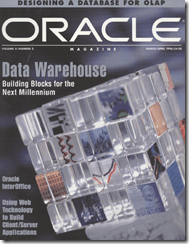
Julie Gibbs, the editor of Oracle Magazine, wondered ‘What will be hot in 2005?’. Some of her predictions/suggestions were:
- Will Larry Ellison’s NC provide every home with a $500 internet box
- What will be the 3 biggest software companies and were any of them around in 1995
- How many people will use the internet everyday
- Will the internet be censored ? How and by whom ?
- Or will the internet be passe and will virtual reality be a reality
- What will be the size of the largest data warehouse
- Will Apple still exist
- Will you be reading your magazines in print or online
- Will your company have a woman CEO
- How many people will be telecommuting
- Will every desktop have built in video conferencing so that you can talk to your coworkers
Other articles included:
- Oracle Interoffice Suite was released and comprised Messaging, Document and Workflow servers based on Oracle 7.3. The product provided groupware functions, such as electronic mail, messaging, scheduling, directory services, document management, workflow and conferencing.
- Oracle 7.3 new features included Oracle Enterprise Manager, Oracle Software Manager, SQL*Net 2.3, advanced replication and Oracle ConText.
- How to rename your database. It is not always optimal for a database to keep the name it was born with. A step by step guide is given on how to do this without loosing any data!
- A case study is presented from NeXT Computer on how to audit and clean up your Oracle Applications data as you prepare to upgrade to Release 10. These included:
- Review Usernames and unused responsibilities
- Unused menus and menu options
- Are outdate concurrent requests being purged
- Unused printers
- Identify cluttered production libraries
- Unused custom concurrent processes
- Unused database objects
- Inactive vendors and invalid distribution sets
- Unused payment terms
- Closed bank accounts
- Protecting your budgets
- Obsolete journal sources
- Invalid price lists
- Unbooked orders and unclosed orders
- Unused payment terms, transaction types, units of measure and inactive sales people
- How to design a database for OLAP. Most of the following steps still stand today for designing your star-schemas
- Define the question (business function/area)
- Use Normalized logic
- Identify Dimensions
- Create Hierarchies
- Identify Attributes
- Identify Measures
- Add Calculations
- There was a review of the very first Oracle Magazine that was published in June 1987. Watch this space, as I will be posting the details soon.
To view the cover page and the table of contents click on the image at the top of this post or click here.
My Oracle Magazine Collection can be found here. You will find links to my blog posts on previous editions.
 Ora-lytics
You must be logged in to post a comment.