
Oracle
2014 A review of the year as an ACED
As 2014 draws to a close I working on finishing off a number of tasks and projects. One of these tasks is an annual one for me. The task is to list all the things I’ve done as an Oracle ACE Director. If has been a very busy year, not just with ACE activities but also work wise too. That will explain why I have been a bit quiet on the blogging side of things in recent months.
In 2014 I one major highlight. It was the publication of my book Predictive Analytics using Oracle Data Miner by Oracle Press. Many thanks for everyone involved in writing this book, especially my family and the people in Oracle Press who gave me the opportunity.
Here is my summary.
Conferences
-
January : BIWA Summit : 2 presentations (San Francisco, USA) **
-
March : OUG Ireland Conference (Dublin, Ireland)
-
April : OUG Norway : 2 presentations (Oslo, Norway) **
-
June : OUG Finland : 2 presentations (Helsinki, Finland) **
-
June : Oracle EMEA Data Warehousing Global Leaders Forum (Dublin, Ireland)
-
August : OUG Panama : 2 presentations (Panama City, Panama) **
-
August : OUG Costa Rica : 3 presentations (San Jose, Costa Rica) **
-
August : OUG Mexico : 2 presentations (Mexico City, Mexico) **
-
September : Oracle Open World (San Francisco, USA) **
-
December : UKOUG Tech15 : 2 presentations (Liverpool, UK)
-
December : UKOUG Apps15 (Liverpool, UK)
That is 19 hours of presenting this year.
** Many thanks to the Oracle ACE Director programme for funding the flights and hotels for these conferences. All other expenses and conferences I paid for out of my own pocket.
My ODM Book
On the 8th August my book titled Predictive Analytics using Oracle Data Miner, was published by Oracle Press. It all began 12 months and 2 weeks previously. I had the book written and the technical edits done by the middle of February (2014). Between March and June the Copy edits and layouts where completed. The book is ideal for any data scientist, Oracle developer, Oracle architect and Oracle DBA, who want to use the in-databse data mining functionality. That way they can use and build upon their existing SQL and PL/SQL skills to perform predictive analytics.
The book is available on Amazon and comes in Print and eBook formats

Oracle Open World
This year I got to go to my second ACE Director briefing. This is held on the Thursday and Friday before OOW. At the briefing we get lots of Very senior people coming in to tell us what is happening with the products in their area and what the plans are over the next 12 to 18 months. Lots of what we are told is all under NDA. My favourite part of this briefing is when Thomas Kurian comes in and talks for about 90 minutes. No slides, no notes. The first 15 minutes is him telling us what Larry & Co are going to announce at OOW, that are the main product directions etc. Then he opens to the floor for questions. You can ask him anything about the set of Oracle products (>3000) and he will explain in detail what is happen. He even commented on the plans for the Oracle Games Console this year!!!
This year I had the opportunity to present at OOW again. It was a joint presentation with Roel Hartman and we had the pleasure of being one of the first presentations at OOW at 8:30am on the Sunday morning. Despite the early start we have really good turn out for our presentation.
Then I got to enjoy OOW with all the various activities, presentations, entertainment and hanging out at the OTN lounge with the other ACEs and ACEDs.
Blog Posts
One of the things I really like doing is playing with various features of Oracle and then writing some blog posts about them. Most of what I blog about evolves around the SQL & PL/SQL Statistics functions and the Advanced Analytics Option, comprising Oracle Data Mining and Oracle R Enterprise. In addition to these blog posts I also have posts relating to various Oracle User Group activities. So there is a good mixture of material on the blog.
In 2014 I have written 60 blog posts (including this one). This number is a little be less than previous years and perhaps the main reason for that is due to me being extremely busy with various project work this year.
OTN Articles
OTN has accepted three articles from me in 2014. I was delighted about these acceptances and I’m looking forward to writing some more articles in 2015 for them.
- Sentiment Analysis using Oracle Data Miner
- ROracle : How to get Started and Commands you need to Know
- Predictive Queries in 12c
I have a few more ideas for articles and I will be writing these in 2015. We will have to wait and see if OTN will accept them.
My Oracle Magazine Collection & Reviews
You may or may not be aware that I’ve been collecting Oracle Magazine for over 20 years now. I have nearly the entire collection of Oracle Magazine going back to the very first edition. Check out the collection here. You will see that I’m missing a few and these are highlighted by the grey boxes. If you do have any of these and you would like to donate to my collection then please get in touch.
One of the things I like to blog about is on some of these old Oracle Magazines. If you go to my Oracle Magazine collection page you will see the past editions that I have writing a review of. Click on the links to view the blog post review an edition.
In 2014 I have written reviews of the following:
- Oracle Magazine-July/August 2000
- Oracle Magazine September/October 2000
- Oracle Magazine-November/December 2000
- Oracle Magazine-January/February 2001
OUG Activities
The Oracle User Group in Ireland (OUG Ireland) has continued to grow this year in membership but also with the number of attendees at our events. In March of each year we have our flagship event which is our annual conference. This year we have almost 300 people and unfortunately people had to turned away at the door because we had headed the maximum limit on the number of attendees for the event. Planing has already commenced for 2015 and the call for presentations is now open. Hopefully 2015 will be bigger and better that 2014. We had a second day at the conference this year where we had Tom Kyte give a full day seminar. Again this was fully booked out for weeks/months before hand. In March 2015 we will be having a second day of the conference with Maria Colgan giving a one day workshop/seminar on the In-Memory option and the Optimiser. You cannot book your place on this seminar yet but then it does open make sure to book your place quick as I’m sure it will book out very quickly.
We also had a number of TECH and BI SIGs and the number of attendees has significantly grown over the past few years. This is fantastic and hopefully this will continue. If it does then maybe we might be able to put on more SIG events.
In the editor of Oracle Scene Magazine which is published by the UKOUG. This was my first full year as editor after spending many years as deputy editor. In 2014 we have published three editions of Oracle Scene and I would like to thanks everyone who has submitted an article. You have helped grow the quality of the contents and also grow the readership numbers. The calls for articles for the Spring edition is now open.
My Oracle Data Science newsletter & My Oracle User Group Weekly newsletter
A couple of years ago I set up a news aggregator based on Twitter feeds and on updates from certain websites. I’ve divided these into two different newsletters. The first is My Oracle Data Science News and as you might guess it is focused on the worlds of Data Science, Predictive Analytics and related developments with a bit of a focus towards the Oracle world. This newsletter gets published each day.
My second newsletter is focused on Oracle User Group activities around the World and is again based on the various Twitter handles of the Oracle User Groups. I’m include over 40 OUG Twitter handles in the aggregator so I should be picking up almost everyone. If you discover your OUG is not being included then drop me an email and I’ll add you to the list. This newsletter goes out every Friday.
Plans for 2015 so far
The start of 2015 is already very busy and I’m already booked for 3 conferences BIWA Summit (CA, USA), OUG Norway and OUG Ireland.
Planing for OUG Ireland is under ways and we are hoping to build on the successes we have had over the past few years.
So as editor of Oracle Scene magazine we are planning for our first issue in 2015, the call for articles is open and we have been busy recruiting authors of articles on specifics.
I’m sure I’ve forgotten a few things, I usually do.
It has been a fun year. I’ve made lots of friends around the World and I look forward to meeting you all at some conference in 2015.
Oracle Magazine-January/February 2001
The headline articles of Oracle Magazine for January/February 2001 were on how the current set of Oracle products supported the development and deployment of mobile and internet applications.

Other articles included:
- Oracle and HP form an alliance to develop and delivery CRM solutions aimed at helping companies keep up with customers in a world where rapid change is common place.
- In Tom Kyte’s regular article he look at and gives examples of using function based indexes, automatically calculating percentages in queries, password protecting the Listener functions, making user lists and securing your data using DBMS_OBFUSCATION_TOOLKIT.
- Oracle announces the release of Oracleportal.com and Oracle Portal Studio.
- Over the past few months Oracle has gone about renaming a number of their products. A full page id give over to this list that maps the old product name to the new product name.
- There was a number of small announcements of collaborations between Oracle and Sun. The start of a beautiful friendship that eventually ended in a marriage.
- Steven Feuerstein had an article on Dynamic Approaches to Multirow Queries. Based on the native dynamic SQL introduced in Oralce 8i he shows us how to handle multiple row results either individually or as a collection.
- In the article on Net8 examples are given showing how net service names are resolved and using LDAP.
- The Oracle 8i Database has components that allow you to take advantage of XML technology. These include XSQL pages, how to install XSQL Servlet, registering the xsql file, processing dynamic xml documents from SQL queries and supporting XSLT tags.
To view the cover page and the table of contents click on the image at the top of this post or click here.
My Oracle Magazine Collection can be found here. You will find links to my blog posts on previous editions and a PDF for the very first Oracle Magazine from June 1987.
OUG Mexico
We (Gorcan, Glen, Debra and I) arrived into Mexico around 10pm and had a few minutes wait for our local user group contact to meet us. They had arranged transportation to our hotel.

The next morning (Friday) was the day of the OUG Mexico conference. We were collected from the hotel and taken to the conference venue. Our transport had to made a number of trips to/from the conference venue to cater for all the speakers, so some of us arrived in the middle of the opening keynote by Noel Portugal from Oracle.

After lunch we had a group photo of all the speakers.
My 2 sessions were on in the afternoon so I got to relax a bit and hang out with some of the other speakers. My first session was on Oracle Data Mine and my second session was on Oracle R Enterprise. Just like in Costa Rica I had a good attendance and again they seemed to enjoy the presentations as they were laughing along at my attempts at jokes 🙂

The Mexico conference was on Friday the 8th August and this was an important day as my book was officially available that day. Just like in my previous countries I had a copy of my book to give away. Here is a photo of me with the winner.

I had the last session of the day. Some of the sessions before this had over ran and I was under a bit of pressure to finish up my last presentation by 5pm. So apologies if this presentation seemed rushed.
Also many thanks to everyone who came up to me afterwards for a chat, to have your photo taken with me and to get my autograph! 🙂
Then it was time to catch a taxi to my next hotel in Mexico city centre. This would be my 6th hotel in 6 days 😦
After checking into the hotel it was time to go for dinner. Renne Antunez had invited some of the speakers to his house for dinner. These was a very enjoyable evening and for me marked the end of my OTN tour. Many of the other speakers were going to over countries over the next week.


Many thanks to Renne and his wife for hosting this dinner, especially as it was Renne’s wife birthday. I hope he bought her a good present.
The next morning (Saturday) I was up at 5am to get a taxi to the airport and my long long travels home, from Mexico to Newark to Dublin getting home on Sunday morning at 8am.
A big thank you to the organisers of the OTN Tour and to each of the countries that invited me to present at their conference. I really enjoyed the experiences and hopefully I can join in another OTN tour sometime soon. Also a special thank you to Vikki in OTN for sorting out all the funding and everything else.
The finals thank you goes out to my travel companions for the tour, Gorcan, Debra and Glen. Without your companionship throughout the week it wouldn’t have been as much fun.
OUG Costa Rica
After the OUG Panama conference we arrived later that night in San Jose the capitol of Costa Rica. The whole emigration, luggage pick up and customs was the smoothest experiences I have ever experienced at an airport. All was done in a matter of minutes. All the booths for emigration and customs was open and staffed. When was the last time you have ever seen this before. It was a very positive start to our short couple of days in Costa Rica. We had arranged for our hotel to have a taxi pick us up and sure enough the driver was there with a good clear sign. From time of landing to being in my hotel room, which was a 20 minute drive, took no more than 1 hour.
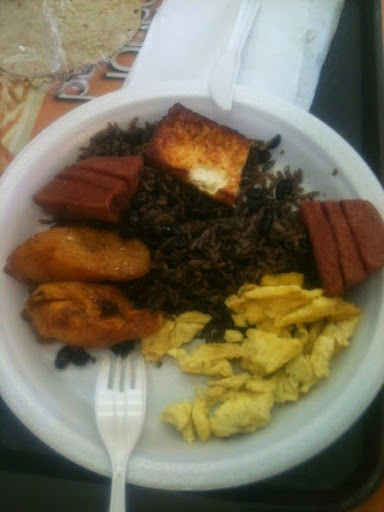
The next morning (Tuesday) we (Debra, Glenn, Gurcan and I) headed out to do some exploring of San Jose on foot. Our first task was to get some breakfast but none of us had any local currency. Debra volunteered to use one of the enclosed ATM machines to get some money. But there was some issue with the machine and she got locked into the cubical. At the same time she got a phone call from her bank in the UK. Her ATM transaction was flagged as a potential fraudulent transaction. I most say Debra’s bank was very quick to contact her and to make all the necessary changes so that she could withdraw some money. After which we had a local breakfast.
Then we sent the next 3 hours walking around San Jose.


Then it was back to the hotel in the early afternoon as the local Oracle User Group had arranged a mini bus to take us up to a hotel that was near the conference location in San Carlos. We had been told that the journey would take 2 hours. Well after 2 hours of driving up hill we were told we were only just over half ways there. It was a long long journey but the views were really beautiful. We had a 10 minute break at little village with a nice church and a really cool garden in front of it.


After anther hour we arrived at the hotel, checked in, and we met up with some other presenters for some dinner. Then it was time for bed as we were being collected at 7:30am.
On Wednesday morning we got collected and taken to the conference venue which happened to be a local university. The User Group had proved a bus service from San Jose to the conference venue and there was a sizeable number of industry people mixed in with some of the university students.


My first presentation was in the auditorium just after the opening keynote. This has to be one of finest rooms I’ve seen and presented in. Even better we had a HD projector. This has to be a first, so I had no resolution issues with running my VMs. I had a really good turn out for my presentation and the photo below shows only some of those who attended.

In the after noon I had my 2nd and 3rd presentations. For my last presentation all the seats were taken and there was even some people standing. There was a lot of people who came to all my presentations which I was delighted with.


After my last presentation I had a raffle for a copy of my book. There seemed to be a lot of interest in this :-). Here is a photo of me with the winner of the book and someone else who was having a read of it afterwards.


This was a very enjoyable conference and the attendees at my sessions were laughing at some of my jokes or maybe they were laughing at me. Anyway I took it that they were enjoying my presentations. For the first time, I had people come up to me after my presentations to have their photography taken with me and to ask me for my autograph.
Here is a picture of the Oracle ACE Directors who presented at the OUG Costa Rica conference.

We were told that our bus journey the day before was the scenic route so that is why it took 3 hours. As soon as the conference was finished we got back on the mini bus to be taken back to our hotel in San Jose. Theoretically it should have been a much quick journey as we were going back the quickest route. This time it took 2 hours 40 minutes.
On Thursday at 2:45am we were woken by a 4.7M earth quake. The room was shaking and everything was shaking in it including me. After breakfast on the Thursday morning, Debra had arranged for us to go on a tour of a Coffee plantation and factory. This coffee tour was hilarious and the best tours I have ever been on. Our tour guides were a comedy double act 🙂


After the tour it was back to the hotel and to get our taxi out to the airport. Did I mention how well operated the airport was. How often have you gone through security when all of the scanners were in operation and fully staffed. This meant that there was almost no queue and I was through security in no time at all. From check in to the departure gate took about 2 minutes.
Our (Glen, Debra, Gorcan and I) next stop was Mexico
BUCKET_WIDTH: Calculating the size of the bucket
Some time ago I had some blog posts introducing some of the basic Statistical function available in Oracle. Here are the links to these.
- The first blog post in the series looked at the DBMS_STAT_FUNCS PL/SQL package, what it can be used for and I give some sample code on how to use it in your data science projects. I also give some sample code that I typically run to gather some additional stats.
- The second blog post looks at some of the other statistical functions that exist in SQL that you will/may use regularly in your data science projects.
- The third blog post provides a summary of the other statistical functions that exist in the database.
Most people do not realise that Oracle has over 250+ statistical functions that are available (no addition cost) in all the database versions.
I’ve had a query about one of the functions BUCKET_WIDTH. The question was wondering if it was possible to get the width of the bucket in each case. There does not seem to be a build in feature to get this value, so we have to calculate this ourselves.
Here is an example of how to calculate the bucket width, as on the example I used in my previous blog post.
SELECT bucket, max(age)-min(age) BUCKET_WIDTH, count(*)
FROM (SELECT cust_id,
  age,
width_bucket(age,
(SELECT min(age) from mining_data_build_v),
(select max(age)+1 from mining_data_build_v),
10) bucket
FROM mining_data_build_v
GROUP BY cust_id, age )
GROUP BY bucket
ORDER BY bucket;

What this query gives is an approximate value of the size of the Bucket Width based on the values/records that are in a bucket. The actual values used cannot be determined exactly as there is not function/value in SQL that tells us the actual value.
OTN Latin America (North) Tour 2014
For a few years now I (and I’m sure you have too) have heard about and followed the various Oracle User Group tours that OTN arranges/facilitates. A tour consists of a number of Oracle User Groups in a region coordinating together to have their conferences organised so that they can get speakers from across the world to come and present.
For most presenters it involves lots of travel. So instead of them doing all that travelling to present at one conference, they can now extend their travels a little and present in a number of countries. Most of the speakers are Oracle ACE Directors and OTN is very generous with their support in that they pay for all the flights, transportation and hotels. Without the generous support of OTN these tours and perhaps many of the conference would not take place.
With envy I used to follow the various speakers on tweeter as they talked about their travels from country to country and their experiences of meeting the people and exploring the various countries. Yes their time in each country seemed to be limited but they always got to see and do so much.
Earlier this year there was an call for presentations for the various OTN Tours in 2014. I submitted 3 presentations that coverd Oracle Advanced Analytics Option (Oracle Data Mining and Oracle R Enterprise). I thought I didn’t stand a chance given the speakers that have participated in previous years.
A couple of weeks ago I received an email saying that I had been accepted onto the OTN Latin America (North) Tour. So you can imagine my excitement. The full OTN Tour North leg covers a number of countries across central and south America and is over a 2 week period. Unfortunately I’m not able to be away for that long, so I was accepted for the conferences on the first week of the tour. This will include Panama, Costa Rica and Mexico 🙂
Some of you might think this is a bit of a golly and a holiday. What I’ve discovered over the past week or more is that it will be far from that. There is a lot of work in preparing the presentations, giving the presentation, setting up live demos between presentation, various meetings with people at the conferences etc etc etc. Then there is all the travel, all the airports, all the airport transfers, all the overnights in hotels. Over the course of 7 days I will be staying 6 different hotels.
I have spent the last week just trying to arrange my flights and hotels. This also involved trying to coordinate with other speakers so that we can travel together as much as possible.
Here are the dates and the presentations that I will be giving at these conferences:
4th August : Panama (in Panama City)
10:00-11:00 : Getting Started with Oracle Data Miner & Predictive Analytics
11:00-12:00 : Combining the Power of R and in-Datbaase Data Mining. Running R in the Database. Seriously!
13:00-13:40 : Sentiment Analysis Using Oracle Data Mining
6th August : Costa Rica (in San Carlos)
10:00-11:00 : Getting Started with Oracle Data Miner & Predictive Analytics
13:00-14:00 : Sentiment Analysis Using Oracle Data Mining
16:00-17:00 : Combining the Power of R and in-Datbaase Data Mining. Running R in the Database. Seriously!
8th August : Mexico (in Mexico City)
14:00-15:00 : Getting Started with Oracle Data Miner & Predictive Analytics
15:00-16:00 : Combining the Power of R and in-Datbaase Data Mining. Running R in the Database. Seriously!
When the agenda for the conferences are available I will have another blog post with their details.
If you are at one of these conference do please say hello 🙂
I’ve finally booked all my flights and hotels. Many thanks to my fellow ACE Director presenters for your research and sharing of travel plans. It looks like there will be a groups of us all travelling together.
Now the next challenge is to prepare the presentations and live demos (yes live demos).
I hope to blog about each of the conferences and my travels to/from each country. It really depends on what time I will have and access to the internet. Perhaps this is something I will try to do on my various plane flights or waiting at the airports. So watch out for these 🙂
Updated with some stats on my travels
My travel plans for the OTN Latin America tour of user group conferences involves
- 12,200 flying miles,
- 29.75 of flying time,
- way too many hours hanging around in airports
- over 8 days
- staying in 6 hotels
- plus 1 over night flight,
- giving 8 hours of presentations in 3 countries
Why do we do this? Because we love sharing with the Oracle User Groups around the world. I’m only doing 1 week of the tour. Some people are doing 2 weeks 😦
Oracle Magazine September/October 2000
The headline articles of Oracle Magazine for September/October 2000 were on e-Business Integration, including online healthy prescription for online retailing, streamlineing the pulp and fiber industries, and the health care industry. Plus there was lots and lots of articles and news items all on businesses delivering solutions via the internet.
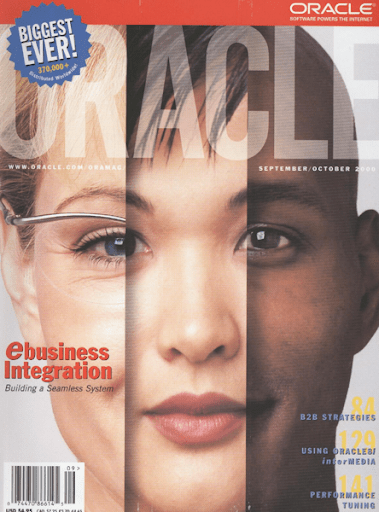
As this was the Oracle Open World edition (and you see the label on the cover saying Biggest Ever) you can imagine there was a LOT of advertisements and sponsored articles. The following of other articles below will not cover these and will only look at the main content articles.
Other articles included:
- Tom Kyte’s article is on Tips for Migrating, Indexing and Using Packaged Procedures. In his article he gives some tips for migrating to Oracle 8.1i. He also discusses some scenarios around creating (or not) indexes on foreign keys. He also looks at the scenario of compiling linked procedures and how the use of packages avoids the identified issues.
- Do you remember the Internet File System. There was an article that gave an overview of this that was available in Oracle 8i and was capable of managing over 150 different file types.
- Autodesk releaseed OnSite, an enterprise solution for bringing design and location based information to the point of work via mobile devices. Autodesk On Site used Oracle 8i Lite and the Palm OS platform to provide an interactive, two way communication environment between the mobile worker and the overall decision support system.
- The Oracle Academic Initiative began in 1997. In 2000 Oracle donated software licences, support services and Oracle training material to 17 educational institutions valued at $60 million
- There was page after page, after page of announcements and news from various Oracle Partners.
- Douglas Scherer gives the first part of an article that looks at how you can use Oracle 8i interMedia for managing and deploying content rich data on the internet.
- Managing Your Resources looks at some of the new Oracle 8i EE helps DBAs to define plan, assign users to groups and prioritise resource allocations.
- With the release of Oracle 8.1.6 came the new Statspack. Connie Dialeris and Graham Wood give an overview of the main features of Statspack, providing some guidance on how to use it in a proactive manner and gives a step-by-step guide to how you can trouble shoot performance problems with Statspack.
- The final article was on Oracle Warehouse Builder (OWB). This was an overview type of article and gave an overview of the main components and gives some guidelines for setting up some different types of integration.
To view the cover page and the table of contents click on the image at the top of this post or click here.
My Oracle Magazine Collection can be found here. You will find links to my blog posts on previous editions and a PDF for the very first Oracle Magazine from June 1987.
Gartner 2014 Advanced Analytics Quadrant
The Gartner 2014 Advanced Analytics Quadrant is out now. Well it is if you can find it.
Some of the companies have put it up on their websites to promote their position.
For some reason Oracle hasn’t and I wonder why?

You can see that some typical technologies are missing from this, but this is to be expected. How much are companies really deploying these alternatives on real problems and in production. Perhaps the positioning of Revolution Analysis might be an indicator. At some point there might be a shift from investigative analysis into more main stream projects and then into production.
What is still evident from this years quadrant is that SAS and IBM (SPSS) still have very dominant positions and perhaps will have for some time to come.
It will be interesting how this will all play out over the next few years.
Oracle Magazine review–May/June 2000
The headline articles of Oracle Magazine for May/June 2000 were on the evolution of organisations into adopting a e-business model. It included 8 steps on evolving to e-business, how to use the Oracle Internet Platform, Web Portal and Java technology.
Other articles included:
- Tom Kyte has an article on Oracle Availability Options and explains when to implement Oracle Parallel Server or replication or a standby database.
- There is a new release of Oracle Discover 3i and Oracle Reports 6i that support XML and are part of the Oracle Intelligent WebHouse initiative.
- Oracle licenced the mobile moddleware developed by Nettech System, to support Oracle’s steps into this field.
- There is an overview of the IOUG-A Live! 2000 conference which is being held between 7-11 May in the Anaheim Convention Centre. Over 4,000 attendees are expected.
- Kelli Wiseth gives and overview of Java 2, explaining the differences between J2SE and J2EE. The article also discusses how Java is part of the Oracle Internet Platform.
- Steven Feuerstein gives the second part of his article on using Java Classes and Objects in the Oracle 8i database.
- Richard Niemiec has an articles on Fundamental Tuning Goals and details the followings:
- Allocate the right amount of memory for the Oracle instance.
- Keep the right data in memory.
- Find problem queries.
- Kevin Loney had an article on how to protect your database from security threats. These included:
- Guard your backups and development environments
- Know your default user and applications accounts
- Control the distribution of database names and locations
- Use auditing effectively
- Make password changes mandatory yet simple
- Isolate your production database
- Venkat Devraj talks discuss six storage tips for 24×7 availability
- Know and understand RAID options
- Choose your disk-array size with caution
- Do not use read ahead caches for online transaction processing applications
- Do not reply on write caches to eliminate I/O hot spots
- Consider using multilevel RAIDS
- Ensure that your stripe sizes are consistent with your OS and database block sizes
To view the cover page and the table of contents click on the image at the top of this post or click here.
My Oracle Magazine Collection can be found here. You will find links to my blog posts on previous editions and a PDF for the very first Oracle Magazine from June 1987.
Oracle Magazine-March/April 2000
The headline articles of Oracle Magazine for March/April 2000 were focused on e-business. There was articles covering the typical issues in setting up an e-business, the technical environment and some reports from organisation who have used the Oracle tools.

Other articles included:
- Oracle releases their Oracle XML Developer’s Kit (Oracle XDK), with support for a variety of programming languages. It included XML Parsers for Java, C, C++ and PL/SQL. XSL Processor, XML Class Generator, and XML Transviewer Java Beans.
- Oracle 8i Lite for the Palm Computing and Psion EPOC operating systems is available.
- Oracle acquires Carleton, who were innovators of data quality and mainframe data extraction software for customer focused data warehousing applications.
- Oracle releases Oracle Fail Safe 3.0 which was used to protect Microsoft Windows NT applications and databases, and supported Oracle 7, 8 and 8i, Oracle Developer Server 6.0 Forms and Reports Servers, Oracle Application Server 4.0 and Microsoft Internet Information Server 4.0.
- Steven Feuerstein has an article about getting started with Calling Java from PL/SQL and gives a simple example to illustrate how to do this. The necessary system privileges included JAVASYSPRIV for the DBA and JAVAUSERPRIV for those schemas who want to call the Java code
- Graham Wood and Connie Dialeris give an overview of Statspack that was was released with Oracle 8.1.6. The article covered the various features, how to install it and how to configure the Snapshot Level & SQL Thresholds. The article also gave an example of how to use DBMS_JOB to automate the collecion of the statistics.
- A Step-by-Step guide on how to use RMAN (that most of use know and love!), including the RMAN architecture, how to setup a backup, starting a backup and the all important step of recovering a backup.
- With Oracle 7 came the ability to Clone a database. In this article it goes through the steps required to setup and clone a production database.
To view the cover page and the table of contents click on the image at the top of this post or click here.
My Oracle Magazine Collection can be found here. You will find links to my blog posts on previous editions and a PDF for the very first Oracle Magazine from June 1987.
12c New Data Mining functions
With the release of Oracle 12c we get new functions/procedures and some updated ones for Oracle Data Miner that is part of the Advanced Analytics option.
The following are the new functions/procedures and the functions/procedures that have been updated in 12c, with a link to the 12c Documentation that explains what they do.
-
CLUSTER_DETAILS is a new function that predicts cluster membership for each row. It can use a pre-defined clustering model or perform dynamic clustering. The function returns an XML string that describes the predicted cluster or a specified cluster.
-
CLUSTER_DISTANCE is a new function that predicts cluster membership for each row. It can use a pre-defined clustering model or perform dynamic clustering. The function returns the raw distance between each row and the centroid of either the predicted cluster or a specified.
-
CLUSTER_ID has been enhanced so that it can either use a pre-defined clustering model or perform dynamic clustering.
-
CLUSTER_PROBABILITY has been enhanced so that it can either use a pre-defined clustering model or perform dynamic clustering. The data type of the return value has been changed from
NUMBERtoBINARY_DOUBLE. -
CLUSTER_SET has been enhanced so that it can either use a pre-defined clustering model or perform dynamic clustering. The data type of the returned probability has been changed from
NUMBERtoBINARY_DOUBLE -
FEATURE_DETAILS is a new function that predicts feature matches for each row. It can use a pre-defined feature extraction model or perform dynamic feature extraction. The function returns an XML string that describes the predicted feature or a specified feature.
-
FEATURE_ID has been enhanced so that it can either use a pre-defined feature extraction model or perform dynamic feature extraction.
-
FEATURE_SET has been enhanced so that it can either use a pre-defined feature extraction model or perform dynamic feature extraction. The data type of the returned probability has been changed from
NUMBERtoBINARY_DOUBLE. -
FEATURE_VALUE has been enhanced so that it can either use a pre-defined feature extraction model or perform dynamic feature extraction. The data type of the return value has been changed from
NUMBERtoBINARY_DOUBLE. -
PREDICTION has been enhanced so that it can either use a pre-defined predictive model or perform dynamic prediction.
-
PREDICTION_BOUNDS now returns the upper and lower bounds of the prediction as the
BINARY_DOUBLEdata type. It previously returned these values as theNUMBERdata type. -
PREDICTION_COST has been enhanced so that it can either use a pre-defined predictive model or perform dynamic prediction. The data type of the returned cost has been changed from
NUMBERtoBINARY_DOUBLE. -
PREDICTION_DETAILS has been enhanced so that it can either use a pre-defined predictive model or perform dynamic prediction.
-
PREDICTION_PROBABILITY has been enhanced so that it can either use a pre-defined predictive model or perform dynamic prediction. The data type of the returned probability has been changed from
NUMBERtoBINARY_DOUBLE. -
PREDICTION_SET has been enhanced so that it can either use a pre-defined predictive model or perform dynamic prediction. The data type of the returned probability has been changed from
NUMBERtoBINARY_DOUBLE.
Oracle Data Miner New Features (SQL Dev 4)
With the release of the new Oracle 12c database and SQL Developer 4 we have a range of Oracle Data Miner new features . Some of these are embedded into the database and are only available in 12c. Check out my previous blog post on these new features.
In this blog post I will look at the new Oracle Data Miner features that come with the ODM tool in SQL Developer4.
The new features of the Oracle Data Miner tool can be grouped into 2 categories. The first category contains the new features that are available to all user of the tool (11.2g and 12c). The second category contains the new features that are only available in 12c. The new features of each of these categories will be explained below.
Category 1 – Common new features for 11.2g and 12c Database users
There is a new View Data feature that allows you to drill down to view the customer object and to view nested tables.
A new Graph Node that allows you to create graphs such as line, bar, scatter and boxplots for data at any stage of a workflow. You can specify any of the attributes from the data source for the graphs. You don’t seem to be limited to the number of graphs you can create.

A new SQL Node. This is welcome addition, as there has been many times that I’ve need to write some SQL or PL/SQL to do a specific piece of processing on the data that was not available with the other nodes. There are 2 important elements to this SQL node really. The first is that you can write SQL and PL/SQL code to do whatever processing you want to do. But you can only do it on the Data node you are connected to.

The second is that you can use it to call some ORE code. This allows you to use the power of R and extensive range of packages that are available to expand the analytic functionality that is available in the database. If there is some particular function that you cannot do in Oracle and it is available in R, you can now embed this function/code as an ORE object in the database. You can then called using SQL.
WARNING: this particular feature will only work if you have ORE installed on your 11.2.0.3g or 12.1c database
New Model Build Node features, include node level text specifications for text transformations, displays the heuristic rules responsible for excluding predictor columns and being able to control the amount of classification and regression test results that are generated. I’ll be covering these in later blog posts.
New Workflow SQL Script Deployment features. Up to now the workflow SQL script, I found to be of limited use. The development team have put a lot of work into generating a proper script that can be used by developers and DBA. But there are some limitations still. You can use the script will run the workflow automatically in the database without having the use the ODM tool. But it can only be run the in the schema that the workflow was generated. You will still have to do a lot of coding (although a lot less than you used to) to get your ODM models and workflows to run in another schema or database.

This will output the script to a file buried deep somewhere inside you SQL Developer directory. Unfortunately in the EA1 release, the size of this location field is small and scrolling has not been enabled. So you cannot (currently) scroll to the end of the field to see the actual location. You can edit this location to have a different shorter location.

Maybe this will be fixed for the official release.
Category 2 – New features for 12c Database users.
Now for the new features that are only visible when you are running ODM / SQL Dev 4 against a 12c database. No configuration changes are needed. The ODM tool checks to see what version of the database you are logging into. It will then present the available features based on the version of the database.
New Predictive Query nodes allows you to build a node based on the new non-transient feature in 12c called Predictive Queries (PQs). In SQL Developer we get 3 addition types of Predictive Queries. These can be used for Anomaly Detection, Clustering and Feature Extraction

It is important to remember that underlying model produced by these PQs to not exist in the database after the query has executed. The model is created, used on the data and then the model deleted.
The Clustering node has the new algorithm Expectation Maximization in addition to the existing algorithms of K-Means and O-Cluster.

The Feature Extraction node has the new algorithm called Principal Component Analysis in addition to the existing Non-Negative Matrix Factorization algorithm.

Text Transformations are now built into the model build nodes. These text transformations will be part of the Automatic Data Processing steps for the model build nodes. This is illustrated in the above images.
The Generalized Linear Model that is part of the Classification Node has a Feature Selection option in the Algorithm Settings. The default setting is Ridge Regression. Now there is an additional option of using Feature Selection.

Prediction Result Explanations gives the scoring details used to to explain why the prediction was made.
Look out for blog post on each of these new features.
 Ora-lytics
You must be logged in to post a comment.